
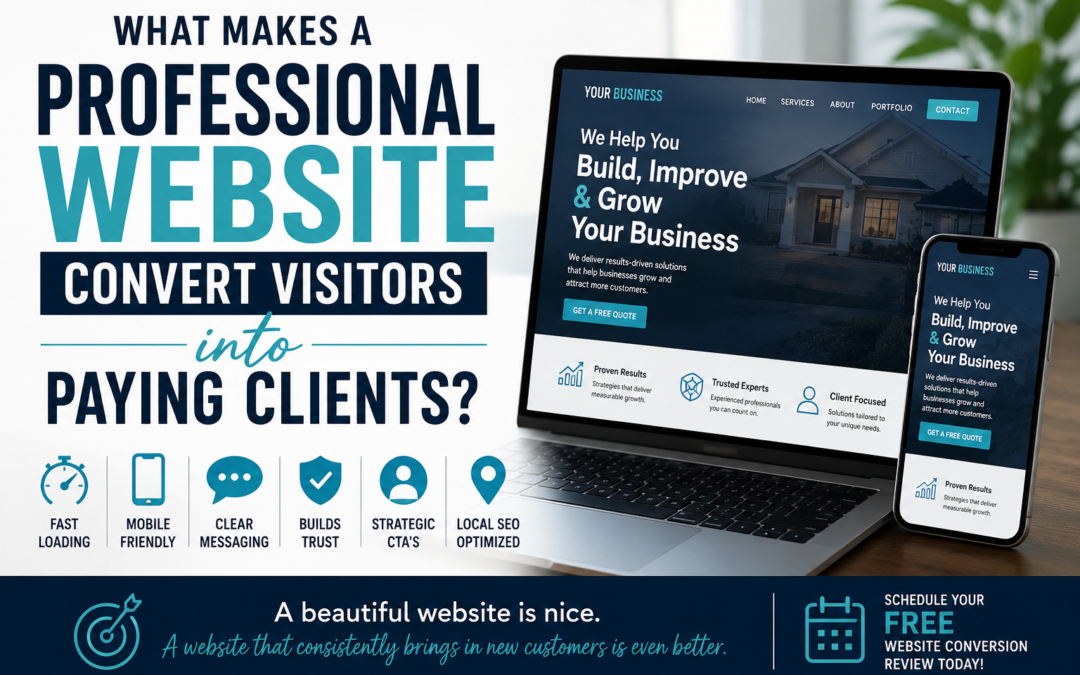
A professional website isn't just something you check off your business to-do list. It's one of the hardest-working members of your team. It's selling your business while you're sleeping, helping customers find you on Google, answering questions, and encouraging people to contact you.
First Impressions Really Do Matter
Think about the last time you searched for a local business.
How long did it take you to decide whether they looked trustworthy?
Probably only a few seconds.
Your potential customers do the exact same thing.
When someone lands on your website, they're immediately judging your business based on what they see. If your site looks outdated, loads slowly, has blurry photos, or is difficult to navigate, many visitors won't stick around long enough to learn how great your services are.
Your website should instantly communicate professionalism.
That means clean design, easy navigation, readable fonts, high-quality images, and a layout that feels organized instead of overwhelming.
People do business with companies they trust. Your website should help build that trust from the very first click.
Can Visitors Tell What You Do Within Five Seconds?
This is one of the biggest mistakes I see.
Business owners know exactly what they do, so they assume everyone else will too.
Unfortunately, that's rarely the case.
When someone lands on your homepage, they should immediately know:
- What you do
- Who you help
- Why they should choose you
If visitors have to scroll halfway down your homepage just to figure out what your business offers, you've already lost valuable attention.
Instead of generic headlines like "Welcome to Our Website," focus on explaining how you solve your customer's problem.
People don't visit your website because they want to learn about your company history.
They visit because they need a solution.
Make that solution obvious.
Every Page Should Have a Purpose
One question I ask every client is simple.
"What do you want someone to do after reading this page?"
If you don't know the answer, your visitors won't either.
Every page on your website should guide people toward taking the next step.
Maybe that's requesting a quote.
Maybe it's scheduling a consultation.
Maybe it's calling your office.
Whatever that next step is, make it impossible to miss.
Clear calls-to-action help eliminate confusion.
Instead of hoping someone contacts you, invite them to do it.
Simple buttons like "Schedule Your Free Consultation," "Request a Quote," or "Contact Us Today" perform much better than expecting visitors to hunt for your phone number.
Trust Is What Closes the Sale
Your website shouldn't just tell people you're great.
It should prove it.
Trust is one of the biggest reasons people choose one business over another.
Fortunately, there are plenty of ways to build credibility online.
Customer Testimonials
Nothing speaks louder than happy customers.
Include testimonials throughout your website instead of hiding them on one page.
Let real people explain what it was like working with you.
Google Reviews
If you've worked hard to earn positive reviews, show them off.
Displaying your Google reviews helps reassure potential customers that they're making the right decision.
Certifications and Experience
Are you licensed?
Certified?
Award-winning?
Experienced?
Include those details.
They help separate you from competitors who don't provide the same level of professionalism.
Portfolio and Before-and-After Photos
Show people what you can do.
Whether you're a contractor, salon owner, landscaper, photographer, or web designer, your work speaks louder than words.
A strong portfolio gives visitors confidence before they ever contact you.
Your Website Has to Be Fast
Nobody likes waiting for a slow website.
Neither do search engines.
A slow website frustrates visitors and often causes them to leave before they even see what you offer.
Google even provides a free tool called PageSpeed Insights where you can test your website's performance and identify opportunities to improve speed.
Large images, outdated plugins, poor hosting, and unnecessary scripts are some of the biggest reasons websites become sluggish.
Speed isn't just about convenience.
It directly impacts user experience, search visibility, and conversions.
Mobile Users Are Your Majority
Take a look around.
Almost everyone is browsing from their phone.
If your website only looks good on a desktop computer, you're losing business.
A professional website should automatically adjust to every screen size.
Buttons should be easy to tap.
Forms should be simple to complete.
Menus should be easy to navigate.
Your customers shouldn't have to zoom in just to read your content.
Google also uses mobile-first indexing, meaning your mobile website plays a major role in how your pages rank in search results.
Local SEO Helps Customers Find You
Having a beautiful website doesn't matter if nobody can find it.
That's where Local SEO comes in.
A professionally built website includes search engine optimization from day one.
According to Google Search Central, businesses should focus on creating helpful, people-first content that answers real questions and provides value. That's exactly what search engines want to reward.
A strong Local SEO strategy includes:
- Keyword-optimized page titles
- Fast loading pages
- Proper heading structure
- Internal links between related pages
- Optimized images
- Location-specific content
- Schema markup
- An optimized Google Business Profile
If you're trying to rank locally, your website should clearly tell Google where you work and what services you offer.
The easier you make that for search engines, the easier it becomes for customers to find you.
Want to improve your rankings? Learn more about our Local SEO Services.
Thinking about replacing an outdated website? Explore our Website Design Services to see how we create websites built to convert.
A Professional Website Is an Investment
Many business owners think of their website as an expense.
I look at it differently.
A professional website is an investment that should generate a return.
It should answer questions before customers ask them.
It should build trust before you ever pick up the phone.
It should bring in qualified leads while you're focused on running your business.
If your website isn't doing those things, it's time to ask why.
Sometimes small changes make a huge difference. Clear messaging, better calls-to-action, faster loading times, stronger SEO, and a more strategic layout can dramatically improve how many visitors become paying customers.
Final Thoughts
A beautiful website is nice.
A website that consistently brings in new customers is even better.
If you're wondering whether your website is working as hard as you are, let's find out.
Schedule your Free Website Conversion Review and we'll evaluate your website, identify missed opportunities, and show you how to turn more visitors into paying clients.